Why drone threats now sit on the risk register
Drones have become cheap, capable and widely available. For operators of critical sites such as airports, power stations, ports, government facilities and military installations, that creates a risk that traditional perimeter security was never designed for: a threat that can arrive from above, with little warning, and sometimes in numbers.
Even a single unauthorised drone can halt operations, compromise sensitive activity or erode public confidence. Boards, ministries and security leaders increasingly expect counter-UAS capability to be part of how critical infrastructure is protected, not a future consideration.
Drone defence for critical infrastructure, governed from the top
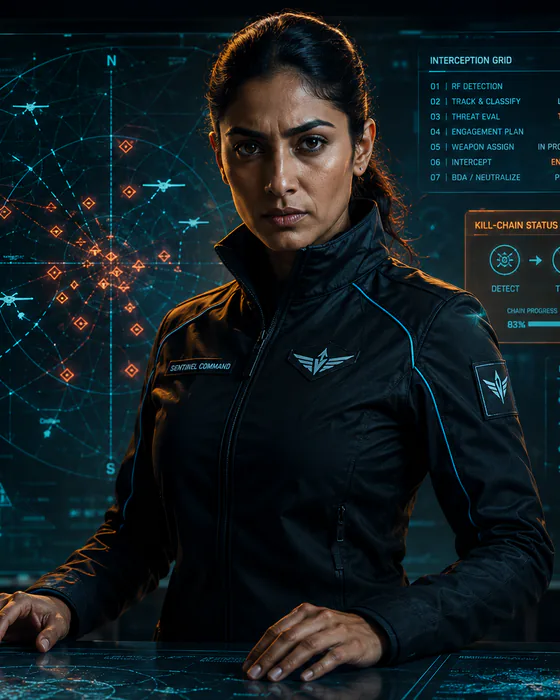
Counter-drone capability raises serious questions about authority, accountability and proportionality. Sentinel is built around a simple principle: people remain in command of every consequential decision, and the system supports them rather than replacing them.
Decisions are made by authorised personnel within the rules of engagement and legal framework that your organisation sets. Sentinel is designed to give commanders and security leaders timely, clear information so they can make those decisions with confidence.
- Human command over every consequential decision
- Authority and responsibilities defined by your organisation
- Clear information for commanders at the moment it matters
- Designed to support proportionate, lawful responses
Every decision audited
When an incident involves a drone near a critical site, what happened next will be scrutinised by leadership, regulators, investigators and sometimes the public. Sentinel keeps a complete record of what was known, who decided what, and when.
That audit trail supports after-action review, training and continuous improvement, and gives oversight bodies the transparency they need to trust the capability over time.
Fitting into your existing security operations
An anti-drone solution should strengthen the security organisation you already have, not create a parallel one. Sentinel is designed to work within your existing security operations, command structures and procedures, so drone incidents are handled with the same discipline as any other security event.
Implementation is planned with your security, operations and legal teams, so responsibilities, escalation routes and coordination with other agencies are agreed before the capability goes live.
Questions leaders should ask before investing in counter-UAS
Counter-drone capability is as much an organisational decision as a technical one. Before selecting any anti-drone solution, security leaders and boards should be able to answer a small set of governance questions with confidence.
- Who holds authority to decide, and how is that authority recorded?
- What legal and regulatory framework governs a response at our sites?
- How will drone incidents be coordinated with police, aviation and other agencies?
- What evidence will we need for investigations and oversight bodies?
- How will operators be trained, reviewed and supported over time?
Procurement readiness and getting started
Vajra products are supplied only to eligible government and defence customers, subject to applicable export and procurement approvals. Engagements begin with a confidential discovery discussion covering your site risk profile, governance requirements and procurement route.
Where appropriate, a private briefing under NDA follows, and then a scoped evaluation agreed with your organisation before any wider deployment. Deployment options, including on-premise, are scoped per customer to meet sovereignty and security requirements.
- Confidential discovery on risk profile and governance
- Private briefing under NDA
- Scoped evaluation agreed with your organisation
- Deployment scoped to sovereignty and security requirements